VOICEPATH TOOLKIT
Self-Evaluation Tools
Explore the Crisis Translation Maturity Model (CTMM) to conduct a self-assessment of your Organisation
HOW TO USE the CTMM’s SELF-ASSESSMENT TOOLS
This section presents the Crisis Translation Maturity Model (CTMM), serving as a practical tool for assessing and enhancing crisis translation capabilities. It is tailored for organisations engaged in crisis response or seeking insights into how to access and offer translation services in crises. The model delineates five levels of maturity across seventeen distinct categories and has been refined for use within this toolkit, building upon prior research.
Table 1 provides definitions for the 17 categories of information to be evaluated. Table 2 provides descriptions for the five assessment levels and the corresponding score ranges that will categorize each level. Table 3 defines the meaning of each category in relation to the organisation’s maturity level. For example, an organisation may self-assess with a score of 4 in the ‘Needs Analysis’ category and a score of 1 in the ‘Legal Framework’ category if they consider themselves more advanced in the former. ]


Table 4 presents a questionnaire model that the organisation can use for research with the involved team. Table 5 proposes a data consolidation model with a final score for each category and a specific field for defining actions to drive transformation. In Annex 1 of this Guide, you can also find tables with detailed definitions of each category by maturity level.
The model was developed using a design thinking methodology, with the involvement of stakeholders from various fields, including INGOs, NGOs, community-based organisations, health and emergency services, local authorities, and language service providers. Co-design workshops were conducted to define information categories and their significance. Extensive discussions with these stakeholders were held to shape the structure and applicability of the CTMM [8
Table 1: Categories of Information
Category of Information
Defined as:
Needs Analysis
The process of identifying the multilingual, multimodal, and/or multicultural communicative needs of stakeholders, taking into account the different crisis phases that may be involved.
Cultural and Political Context
The cultural and political aspects that may influence, sometimes in unexpected or unanticipated ways, the reception of crisis communication and hoped for behaviours.
Communicative Context
The multidimensional context in which crisis communication takes place, across all phases and types of crisis.
Ethics
The principles, either at a governmental, organisational or individual level, that guide decisions, policy and practice as applied to crisis communication and, specifically, to the (non-)provision of essential information to those who are impacted in a language that can be understood and a format that can be accessed in all phases of a crisis.
Legislative Frameworks
International, national, or regional guidelines, laws, or covenants that specify the legal obligations of those organisations engaged in crisis communication. These obligations are rooted in human rights and can entail responsibilities across a broad range of dimensions including data protection, employment, health and safety, property, non-discrimination and accountability.
Information and Digital Literacy
The varying levels of ability of those impacted in a crisis to read, write or understand crisis communication and to find, evaluate or communicate using different media.
Organisational Responsibility
Recognition by the organisation of its responsibility to endorse and support crisis translation services and embed such services into its organisational structure. This category might encompass a broad range of activities such as implementation of needs analysis, training, creation of a policy, quality evaluation, creation of resource databases, advocacy etc.
Complexity of Translation
Recognition by the organisation that translation is not a literal word-for-word replacement activity and is instead a complex, cross-linguistic, cross-cultural, contextually-dependent, technical and specialised activity that normally requires a professional who has been trained and who demonstrates an agreed set of skills and competences. It recognises that translation might involve spoken translation (i.e. interpreting), sign-language interpreting for the deaf community, and translation into braille for the blind community and highly technical expertise (for subtitling or dubbing, for example).
Policy
Written or unwritten, formal or informal statements of intent by an organisation on their approach to the provision of crisis translation.
Resource Databases
A collection of data – normally online – containing information of relevance to the provision of multilingual, multicultural crisis communication.
Budget
Financial resources dedicated to the provision of translation for all stages of crisis response and for any related activities
Feedback Mechanisms
Technology that Supports Translation
Technology that Supports Translation
All specialised computer tools that seek to assist the process and product of translation and related, peripheral computer tools. This might include, but is not limited to: translation memory tools, machine translation, audio-visual translation tools, terminology management, collaboration platforms, translation project management tools, speech to speech and speech to text tools, and tools for aiding simplification of text.
Quality
The level of quality of any translated and interpreted content, tools that aid its instantiation and its measurement, awareness and implementation of procedures that facilitate, measure or assess quality, training to improve the quality of translated products in crisis communication, awareness of the need for quality and the impact on affected people if quality is not at a necessary level, budget required to ensure quality.
Risk Assessment
Proactive processes implemented by those responsible for crisis translation to assess and mitigate risks if information is not provided in multiple languages and appropriate formats or at appropriate quality levels in all phases of a crisis.
Training
Any formal or informal assessment of training needs and implementation of training relating to the provision of multilingual, multicultural, multimodal crisis communication and related processes or tools.
Trust Building and Management
All activities between those responsible for crisis translation and targeted communities to co-create and manage trust and any tools, resources, training and other assets and activities that might enable the creation and maintenance of trust.
Table 2: Maturity Levels
LEVEL
LEVELS OF MATURITY*
SCORE
AD HOC
Process management systems are initiated
1
REPEATABLE
Consistent management processes are applied
2
DEFINED
Processes become well defined, documented, standardised
3
MANAGED
Development and application of quantitative performance measures
4
OPTIMISING
Organisational commitment to continual improvement
5
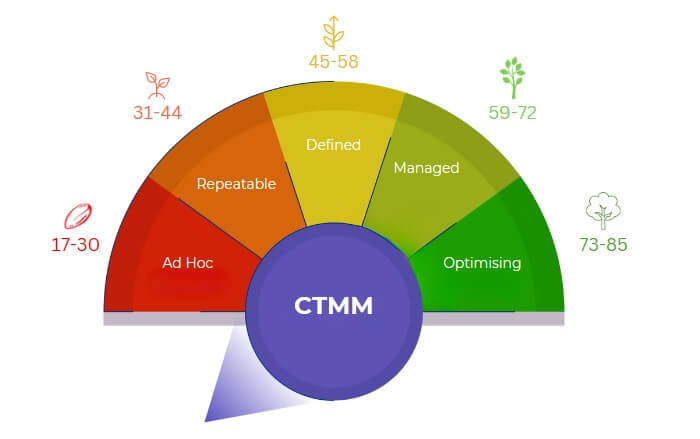
*The color codes used signify varying levels of maturity in crisis translation, with red indicating the lowest or least mature stage (ad hoc), followed by orange (repeatable), yellow (defined), light green (managed), and dark green (optimising) representing the highest or most mature stage.
Table 3: Levels and Categories
Category
Level 1: Ad Hoc
Level 2: Repeatable
Level 3: Defined
Level 4: Managed
Level 5: Optimising
Preliminary analysis of communication required, languages, modes and platforms; focus on response
Fundamental and emerging needs are addressed and prepared for; from reactive to proactive
Analysis systematised to identify regular needs, reduce redundancy, and manage resources through regular feedback
Key performance indicators analysed to respond and prepare for future needs
Needs beyond immediate crisis settings can be approached and anticipated; focus on preparedness
Awareness of cultural and political context that determines how crisis information is received
Awareness of potential for cultural and political factorsto shift and change as crisis develops
Feedback leveraged to recognise cultural specificity of local context, relationships, and collaborations; interlocked with trust building
Representation amongorganisational members and collaborators reflects cultural and political context
Cross-cultural engagement, including outside immediate crisis, and diversity of representation continuously improved
Awareness of broader communicative context and its impact on crisis translation efforts
Channels established to engage in clear, simple,contextually appropriate and effective communication
Information, communication protocols, channels, and formats formalised; awareness of plans for contextually effective dissemination raised
Contextually appropriate communication and translation style guidelines established; translation quality measured against them
Understanding of communicative context, including outside immediate crisis, continuously improved; focuson prepare
Preliminary discussion of ethical implications of decisions
Specific measures related to decision-making, communicative efforts, and staff safety and well-being implemented
Guidelines on when to use translators and interpreters shared;ethics of quality, privacy, and confidentiality systematically addressed
Diversity of organisational members and collaborators measured; stakeholder provision of feedback on organisational performance compensated
Focus on transparency and accountability to stakeholders, including outside immediate crisis
Basic measures on data protection taken; broader principles of law begin to inform and regulate efforts
Clear guidelines on all relevant legislation established
Measures to influence relevant policy-making and legislation taken
National and international comparisons made to measure performance with respect to relevant legislation; communication with stakeholders to ensure they know their rights and relevant rights-based legislation
Sustained commitment to meeting national and international legislative obligations and protecting staff well-being; advocate for improved legislation and regulations in both the national and international arenas
Awareness of different levels of literacy among targeted recipients
Fundamental andemerging literacy needsare addressed and prepared for;focus on clear, plain, contextually effective communication
More sophisticated, multimodal approaches to engage with literacy levels identified and applied
Knowledge of literacies used to establish communication and translation style guidelines
Understanding of literacies, including outside immediate crisis, continuously improved
Need for key internal stakeholder responsible for crisis translation considered
Process reviews used to consolidate key organisational roles, job descriptions, and stakeholder collaborations
Language support embedded in organisation’s communication strategies and key practices and protocols; relevant budgetary needs understood and advocated for
Crisis translation performance linked to broader organisational key performance indicators
Increasingly advanced qualitative and quantitative indicators set, regularly evaluated, and appropriately resourced
Awareness that translation is more than simple word matching done by bilinguals or machine translation
Standard operating procedures that encodecomplexity of translation implemented and reviewed periodically
Staff training on appropriate use of translation technologies and resources considered
Complexity of translation acknowledged in measurement of organisational performance
Consolidated crisis translation project management system run to professional standards employed
Preliminary crisis translation policy developed but not yet in writing
Crisis translation policyencoded and placedwithin broader organisational policies on communication
Crisis translation policy known and understood by internal and external stakeholders
Crisis translation policy and rolesreviewed based on organisational performance and comparisons
Crisis translation policy regularly and consistently evaluated and reviewed; helps shape organisation’s higher-level policy direction
Database of resources required for crisis translation begins to be compiled
FAQ for users of organisational databases established
Databases managed, updated, and deployed by internal stakeholder responsible for crisis translation policy; staff training in use and maintenance of databases provided
Databases used as a data source fororganisational performance evaluation
Databases integrated into a consolidated crisis translation projectmanagement system run to professional standards
Preliminary budgets for crisis translation and its promotion established, even if this means reallocating funds from non-crisis operating budgets
Budgets expanded to address training, resource and relationship building, and staffsafety and well-being
Regular budget allocations for a standardised protocol to deploy crisis translation, train personnel, support their well-being, and fund a person who is responsible for crisis translation and its quality assurance
Budgets allocations for training on effective performance measurement and stakeholder feedback incentivisation
Budgets refined and made more transparent; budget allocations for crisis translation project management system and internal and external advocacy work
Initial processes for two-way communication with recipients of crisis translation established
Processes expanded beyond recipients to include staff and stakeholder debriefing
Recipient, staff, and stakeholder feedback appropriately incentivised and included in periodic organisational performance reviews
Feedback responded to effectively andefficiently and leadsto policy review
Positive and open feedback loops in placefrom all levelsof the organisation and its external counterpart
Awareness of how technologies that support translation could be utilised
Use of translation technologies standardised and resources (developed; possible deployment of translation technology internally to facilitate organisational operations
Translation technologies embedded in organisational practices; stricter quality controls employed; staff informed and trained on best use of translation technologies
Performance of technologies measured; focus on technological opportunities but also risks
Technologies integrated into consolidated crisistranslation project management system
Awareness of need for high quality translation products, processes, and policies but no concrete measures in place to assure this
Processes, tools,and policies that facilitate higherquality crisis translation established
Crisis translation quality begins to be assured by the organisation
Adoption of flexible and contextually appropriate concept of qualityand measurement using established communication and translation styleguidelines
Quality assured. Organisational evaluations, well-funded staff training, and a comprehensive and technologically integrated project management system
Category not considered at this level
Imminent risk to crisis translation success identified and mitigated where possible
Broader andmore systematic consideration of risk to include quality, ethics, and operations; mitigation through policy and practice considered
Risks afforded by technological developments monitored
Longer-term risks to staff safety and well-being mitigated
Category not considered at this level
Staff training implemented as organisation attempts to clarify its crisis translation roles and relationships, use more sophisticated resources, and meet its legal and ethical obligations
Specialised training on how to work with translators and interpreters, use technologies and recognise the complexity of translation implemented
Training on how to measure translation and communication performance effectively implemented; training offering adapted as needs evolve
Training on ethics, feedback implementation, and project management systems implemented; commitment to continuous improvement of training
Category not considered at this level
Relationships of trust with key stakeholders built
Relationships of trust with key stakeholders built and managed over longer term
Focus on contextually appropriate representation among organisational members and collaborators to deepen trusted connections with communities
Focus on budgetary transparency, cross-cultural engagement, and internal and external advocacy to increase trust


